

 September, 2025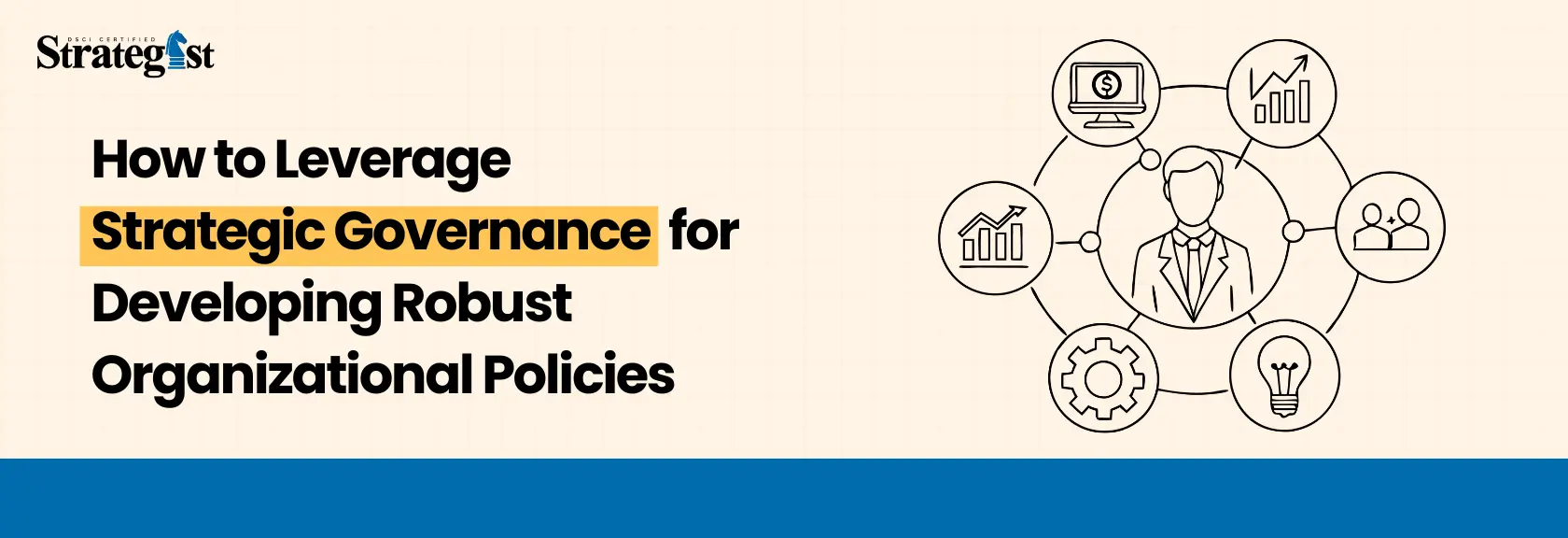
Living in the techade, defence against security and privacy challenges becomes an integral part of today’s business success. In achieving that, organizations work tirelessly to meet set priorities and compliances. But what often contributes to the incomplete realization of their goals is the presence of a faltering strategy.
A discipline that optimizes workflows for business processes but extends beyond the operational consideration is strategic governance. Serving a long-term vision, the governance rests on the pillars of:
The ethos of strategic governance, thus, maintains a critical balance between risk optimization and control. When bad actors are round the corner working to infiltrate the security and privacy ecosystem, insider vigilance becomes a priority. Most importantly, a good strategy provides the much-needed clarity in operations.
Therefore, strategic governance when aligned with an organization’s policy framework can help improve the leadership and decision-making posture. A move necessary to achieve resilience with evolving security and privacy paradigms.
Stakeholder engagement also happens to be one of the principal areas of consideration for business success. It furthers an organization’s vision by driving long-term objectives. Better collaboration gives room for innovation and supports successful risk mitigation. At the same time, good engagement brings the promise of reputation building and better project execution.
However, this engagement needs to be built gradually for improving the organization’s overall stance. Transparent discussions over shared concerns can enhance decision outputs, while involving stakeholders in faced challenges helps identify apt solutions and develop partnerships. Most importantly, consistent delivery strengthens and sustains this relationship.
Ethics acts as the cornerstone of credibility. Incorporating its principles of fairness, transparency, and accountability strengthen internal trust and enhance external reputation. With security and privacy concerns dominating, ethical governance becomes a distinguishing factor for sustainable resilience.
These practices or areas of consideration are only the first step towards a robust policy framework, all made possible with strategic governance. Moreover, when one leads boardrooms and deliberates on everyday security risks, and privacy challenges——better governance becomes the iron pillar of the organization.
Teams and leaders can also benefit from tailor-made executive programs and certifications that add to their credibility in the decision-making process. Honing the strategist within is the imperative for today.
More details on the subject of strategic governance can be learned at: https://www.dsci.in/content/dsci-certified-strategist-program-dcsp
Sources:
https://www.onetrust.com/blog/building-a-strategic-framework-for-policy-governance
https://www.undp.org/accountability
Author: Mridushi Bose
Operational Office – 4th Floor, NASSCOM Campus, Plot No. 7-10, Sector 126, Noida, UP -201303
In Association

